Posts

Good Tests, Bad Tests: Can The Testing Fanatics Tell The Difference?
Image
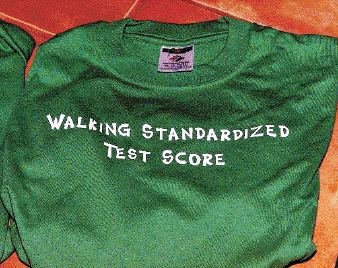
And do they really care? Consider the following problem: ===================================== 3, 4, 6, 7, 10, 12 The number n is to be added to the list above. If n is an integer, which of the following could be the median of the new list of seven numbers? I. 6 II. 6 1/2 III. 7 (A) I only (B) II only (C) III only (D) I and III only (E) I, II, and III ============================================== In considering your evaluation of the question, you may wish to know the following facts: this is the 13th of 16 questions for which the total time allotted is 20 minutes. The question appeared on the last of three mathematics sections and on the 8th of 10 sections overall in an exam that takes a total of 225 minutes. The test is one commonly used as part of college admissions in the United States. What factors enter into your determination of how good or bad a question this is? What assumptions are you making, if any, about what comprises a good mathematics assessment in general? Some inte...

Whispered Policies

Image
Friday's Chronicle reports on a new study that points out how difficult it can be to identify which colleges and universities have no-loans policies designed to enhance affordability. Author Laura Perna and her colleagues find that the majority of elite institutions with these policies fail to advertise them in ways that are accessible to low-income students and families-- effectively maintaining their status as "bastions of privilege." The researchers then go on to make several helpful suggestions about how colleges could change their tactics to increase awareness and uptake of their progressive efforts. But they could've gone one step further and discussed the incentives colleges have to maintain the status quo-- that is, to continue making their current and former students and staff feel good with liberal actions, garnering attention in elite venues such as the New York Times , without fundamentally changing their overall enrollment demographics or costing too mu...

Overhauling Teacher Prep

Image
U.S. Secretary of Education Arne Duncan's call for an overhaul of teacher preparation programs is certainly warranted. Reports such as Arthur Levine's in 2006 have highlighted weaknesses in the training received by many graduates of traditional, university-based teacher preparation programs. I'm one however who believes that there is role both for university-based as well as alternative providers of teacher preparation, such as Teach For America and The New Teacher Project. In a policy brief for the New Teacher Center (and related blog post ), I discuss some promising partnerships between institutions of higher education and school districts -- teacher training pipelines that by and large provide the hands-on experience and training called for by Secretary Duncan and contained within many other diagnoses of what ails traditional teacher prep. Likewise, the Carnegie Corporation's Teachers for a New Era initiative provides evidence of what effective university-based p...

The Stories We Tell Ourselves

Image
Once upon a time, college students could pay their tuition with a mix of family support, financial aid, and perhaps a little work. Today, family support and aid are woefully inadequate for a broad swath of undergraduates, and full-time work is common. Is working while in college truly necessary? Are the earnings used for academic expenses related to postsecondary education, or are they frittered away on life's pleasures? Since a handful of studies indicate a negative association between working long hours and rates of degree completion, these questions have taken on broader significance. Unfortunately, few studies track students' income and expenditures in systematic ways. To better understand spending patterns, and attempt to tease out the reasons for those patterns, one would ideally have longitudinal data collected for a large sample of students, and complemented by in-depth interviews with a sub-sample of students to delve more deeply into the reasons underlying decisio...

Teachers' Voice

Image
An important survey was released this week that captures teachers' perceptions of their professional working environment. The national study of 900 teachers by Public Agenda describes educators as falling into one of three groups: "Disheartened," "Contented," and "Idealists." It also raises some serious policy implications for the placement, retention and longevity of teachers based on teachers' perceptions about working conditions, why they entered the profession, and their opinions about proposed policy reforms. But as useful as this survey may be in defining these issues at a 30,000-foot level, it does not approach the power and utility of teacher surveys that offer entire populations of educators in individual states and districts the opportunity to share their voice about working conditions, leadership support, resources, opportunities for professional learning, etc. In turn, these anonymous surveys also provide contextualized, customized s...

Democrats, Poverty, and Schools

Image
Renewing the War on Poverty clearly needs to be one of President Barack Obama's main objectives during the coming years. As Barbara Ehrenreich and so many others are documenting, the deteriorated safety net is failing poor people during this recession, leaving them in dire straits. So when Nick Kristof decided to pen a column for the New York Times urging the Democrats to again lead a fight against poverty, his heart was in the right place. But his aim was way off. On Thursday, he wrote that the Dems must focus on public schools, since they "constitute a far more potent weapon against poverty than welfare, food stamps or housing subsidies. " Huh? Social science researchers across the nation are scratching their heads. Where in the world did Kristof get this one? For decades, solid analyses have demonstrated that while aspects of schooling can be important in improving student outcomes and alleviating the effects of poverty, the effects of factors schools cannot and...

California Knocks Down Data Firewall

Image
California is adept at building firebreaks to stop advancing wildfires throughout the state. The inferno that is the student-teacher firewall issue was apparently doused yesterday when Governor Arnold Schwarzenegger signed a bill that eliminates a statutory ban on using student achievement data to evaluate teachers. The existence of such a restriction would have deemed California ineligible for a federal Race to the Top competitive grant award. Here is the Governor's press release. Here , here and here are background posts on the student-teacher data firewall issue in California.